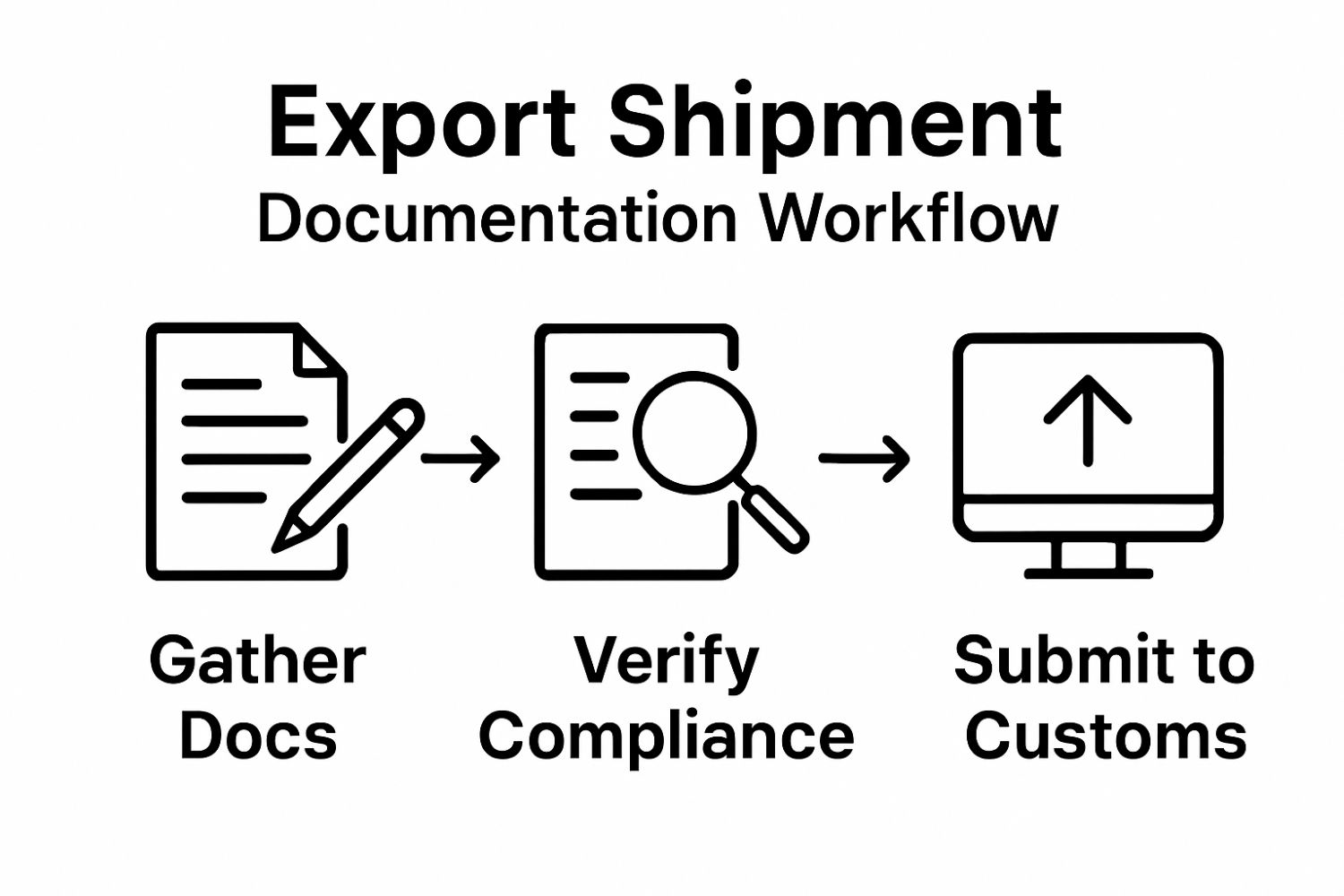

Your shipment is finally ready. The factory has packed every carton, the forwarder has booked a sailing, and you are about to send your first container of goods from China to your warehouse. Then the forwarder asks: “What are the shipping marks? Make sure they match the bill of lading exactly.” You hesitate. The boxes have numbers and a logo, but is that enough? You start searching online for standard shipping marks, only to find conflicting advice and no clear checklist for a shipment departing China.
Drawing on our daily work as a sourcing agent coordinating shipments for global brands, we have seen how a single missing label or inconsistent document can turn a smooth clearance into an expensive, multi‑week delay. This guide provides you with a step‑by‑step framework for designing compliant shipping marks, avoiding the most common customs mistakes, and adjusting your markings for different transport modes—so your goods keep moving and your landed cost stays predictable.
Basic Definition and Mandatory Contents of Standard Shipping Marks
Differences and Functional Division Between Main Marks and Side Marks
Shipping marks refer to all text and symbolic patterns printed on export outer cartons. These marks can effectively identify cargo information and provide standardized handling instructions for warehouse staff and carriers. Shipping marks are divided into two core types with different application functions.
Main marks are printed on the front side of export cartons. They help shipping carriers and consignees confirm the ownership and basic attribute information of cargo. Side marks carry key operational data of shipments. Port operators, warehouse staff and truck drivers rely on side mark information to complete safe cargo handling and transportation work.
Unclear main marks will easily cause cargo mixing problems in consolidated warehouses. Incorrect or missing side marks will lead to irregular cargo handling, such as upside-down stacking of cartons. These problems are not hypothetical risks. We once arrived at a factory to find 200 cartons printed with only a product name—no PO number, no destination port. A total of 200 cartons only printed simple product names, without PO numbers and destination port information. This situation made forwarders unable to complete accurate cargo identification in container freight stations and directly affected subsequent shipment arrangements.
Mandatory Marking Information: Consignee, Destination, Carton Number, Origin and Weight Data
The marking contents listed in the table below are the basic information that must be printed on all export cartons. These standard requirements apply to all transportation modes and are the unified identification baseline recognized by customs institutions, freight forwarders and warehouse receiving parties worldwide.
| Element | Example | Notes |
|---|---|---|
| Consignee / Buyer identification | ABC Imports, PO#2345 | Can be a company name, brand logo, or buyer-assigned code such as a PO number. All information must be consistent with the consignee information on the bill of lading. |
| Port of destination / final destination | NEW YORK, USA | Sea freight shipments can adopt standard three-letter port codes such as NYK to replace full port names. |
| Carton number | C/No. 5/200 | The marking needs to include the current carton serial number and the total quantity of cartons in the whole batch. This information is the core basis for verifying the integrity of received shipments. |
| Country of origin | MADE IN CHINA | Required by law in most countries, including under U.S. 19 CFR 134. The content must be permanently printed and clearly displayed on all outer cartons. |
| Gross weight and net weight | G.W. 18 kg, N.W. 16 kg | Useful for handling and customs valuation. Usually printed in the side mark area. |
| Carton dimensions | 45 x 35 x 30 cm | Size data helps carriers formulate palletizing schemes and complete reasonable container loading arrangements. |
Interpretation of International Universal Cargo Handling Symbols
In addition to text information, cartons need to be printed with international standard handling symbols formulated based on ISO 780 specifications. These symbols allow logistics staff to quickly grasp cargo handling requirements without reading text content.
The most common symbols include “THIS SIDE UP” (two arrows pointing upward), “FRAGILE” (a broken glass symbol), “KEEP DRY” (an umbrella), and “STACK LIMIT” (a number inside a triangle). All symbols need to be printed with black ink on light-colored carton surfaces. It is best to print symbols on at least two sides of each carton. This is especially important for LCL shipments, where cartons may be re-stacked and handled multiple times during transit.
Common Shipping Mark Errors Leading to Customs Clearance Delays
Information Inconsistency Between Carton Marks and Official Documents
Core export documents include commercial invoices, packing lists and bills of lading. All three documents have a dedicated “Marks and Numbers” column. The mark information filled in these three positions must be completely identical.
Even small inconsistencies can trigger a customs examination. For example, if the packing list is marked with “ABC 2345” while the bill of lading shows “ABC#2345”, customs officers will identify information discrepancies and initiate physical cargo inspection procedures.
Our team once handled a delayed shipment case caused by this error. The factory added an extra horizontal line between the order number and carton quantity on the carton mark, but the corresponding symbol was not added on the commercial invoice. This small difference led to the container being detained at the destination port for four days for document verification. This risk can be completely avoided through comprehensive pre-shipment document cross-inspection work.
Missing or Non-Standard Country of Origin Labels
U.S. 19 CFR 134.11 regulations clearly stipulate that all imported goods must be printed with clear country of origin marks. The marks need to be placed in conspicuous positions, maintain permanent legibility and remain intact until the goods reach end buyers.
Temporary stickers that easily peel off during transit do not satisfy the requirement. If individual retail products are only marked on outer master cartons without independent marking, they will also be judged as non-compliant. Our team has encountered shipments detained by customs because the factory printed “Made in PRC” instead of the standard “Made in China”. Customs regarded this expression as incomplete and non-compliant marking.
In addition to product cartons, wooden packaging materials such as pallets and crates have independent marking requirements. All wooden packaging for export must be printed with standard IPPC stamps that comply with ISPM 15 specifications. Shipments without qualified stamps will face quarantine disposal or return risks.
Confusion Between Amazon FBA Labels and Standard Shipping Marks
Many Amazon cross-border sellers confuse FBA carton barcode labels with formal shipping marks. The scannable FBA labels generated by Amazon Seller Central are only applicable to internal sorting and circulation in Amazon’s warehousing system after customs clearance.
FBA labels cannot provide effective consignee and destination information for forwarders, customs brokers and port terminals. All cartons for Amazon FBA shipments still need to be printed with complete standard shipping marks. The mandatory marking contents include forwarder consignee information, destination port and compliant “MADE IN CHINA” labels.
We suggest sellers paste FBA exclusive labels on one side of cartons and print standard shipping marks on adjacent sides. This layout ensures both Amazon warehouse staff and customs officers can clearly view the required information.
Differential Marking Standards for Different Transportation Modes
Marking Differences Between FCL and LCL Ocean Freight
FCL full-container shipments adopt fully sealed container transportation modes. Cartons will not be opened or transferred midway from factory loading to destination unloading. The identification function of shipping marks is relatively weak during sea transportation.
However, after containers arrive at the destination port, cargo unloading and carton distribution work will be carried out. Standard marks are still essential to ensure accurate cargo distribution. LCL consolidated shipments have completely different risk characteristics. Such cargo will be stored and sorted with goods from other shippers in container freight stations.
Clear and complete main marks are the only basis to distinguish independent cargo batches. For LCL shipments, our team recommends adding buyer exclusive codes and PO numbers to main marks to avoid cargo mixing losses.
| Feature | FCL | LCL |
|---|---|---|
| Transit handling frequency | Only handled during origin loading and destination unloading | Repeatedly sorted and handled in origin stations, transshipment warehouses and destination stations |
| Cargo mixing risk | Low, due to sealed container protection | High, due to mixed storage with multiple batches of goods |
| Basic marking requirements | Country of origin, carton serial number and handling symbols | Complete main marks (buyer code, PO number, destination port) and full side mark data |
| Key inspection focus | Container seal integrity and container door marking information | Full inspection of marking authenticity and standardization on single cartons |
Special Marking Rules for Air Freight and Express Delivery
Air freight shipments have fast circulation efficiency. The airway bill (AWB) number serves as the main cargo identification basis in the whole transportation process. Even so, all cartons must be printed with complete shipping marks.
The mandatory marking contents for air freight include consignee information, three-letter destination airport code and standard country of origin labels. For commercial express services such as DHL and FedEx, the official tracking labels provided by couriers can complete most cargo identification work.
Customs departments will still inspect the country of origin marks and document consistency of express shipments. Many sellers only rely on courier tracking labels and omit origin marking, which will directly lead to shipment rejection at destination transit hubs.
Marking Specifications for Wooden Packaging and Hazardous Goods
All export goods packed with wooden crates or solid wood pallets need to meet ISPM 15 international standards. Wooden packaging materials must be heat-treated or fumigated, and printed with qualified IPPC anti-quarantine stamps.
To ensure inspection pass rate, merchants need to print IPPC stamps on at least two opposite sides of wooden packaging. For special hazardous goods such as lithium battery products, outer packaging needs to be printed with standard UN numbers and hazard classification labels on the basis of conventional shipping marks.
The marking information of hazardous goods must be completely consistent with the contents of Material Safety Data Sheet (MSDS) and Dangerous Goods Declaration. Any information mismatch will lead to shipment suspension at the origin port and affect normal delivery schedules.
Main Customs Document Errors and Standard Avoidance Methods
Low-Declaration of Cargo Value on Commercial Invoices
Some suppliers will suggest merchants underreport cargo value on commercial invoices to reduce import duty costs. This behavior belongs to illegal customs fraud and brings huge hidden risks to import enterprises.
U.S. 19 USC 1481 regulations clearly require that the declared value of all imported goods must be consistent with the actual transaction price paid by buyers. U.S. CBP customs has the right to seize underreported shipments and impose corresponding fines.
Companies with a history of undervaluation can be placed on a CBP watch list, triggering inspections on every subsequent entry. All subsequent import shipments will face enhanced inspection intensity. In all shipment projects undertaken by our team, we strictly require invoices to fill in true transaction values and retain complete payment voucher records to respond to possible customs audits.
HS Code Misclassification and Subsequent Risks
An incorrect HS code is one of the most common customs errors in international trade. Wrong code filling will lead to many adverse consequences, including excessive duty payment, insufficient duty payment and subsequent tax supplementary penalties, and mandatory customs physical inspection.
Some products are subject to anti-dumping and countervailing duty restrictions. Intentional or unintentional wrong code classification that bypasses tariff restrictions will trigger official customs investigation procedures.
Merchants need to query and confirm the accurate 10-digit commodity code through the official U.S. Harmonized Tariff Schedule (HTS) platform. For products with ambiguous classification attributes, it is necessary to consult licensed customs brokers or apply for official binding ruling documents from CBP in advance.
In our daily China product sourcing work, our team completes accurate HS code classification at the product sampling stage. We confirm unified coding standards before mass production and shipment to eliminate subsequent customs risks.
Missing Qualification Certificates for Regulated Products
Products involved in special industry supervision need to provide targeted qualification certificates for customs filing. Multiple U.S. regulatory agencies including FDA, FCC and CPSC have formulated clear entry standards for specific commodities. Missing certificates will directly lead to customs clearance failure.
The table below sorts out common supervised commodities and their corresponding mandatory certification documents.
| Product Type | Required Certificate / Filing | Supervision Agency |
|---|---|---|
| Radio frequency electronic equipment | FCC Declaration of Conformity | FCC |
| Food contact packaging materials | FDA Food Contact Substance Notification | FDA |
| Children’s toys and baby products | Children’s Product Certificate (CPC) | CPSC |
| Cosmetic products | FDA Cosmetic Product Ingredient Statement | FDA |
| Textile and apparel products | Flammability test certificate | CPSC |
Our team cooperates with ISO-accredited professional laboratories to complete all product testing and certification work during the production cycle. We assemble complete export document packages before shipment booking to ensure zero missing certificate risks.
Professional Sourcing Service Support to Avoid Mark and Customs Errors
On-Site Pre-Shipment Mark Inspection Checklist
As a professional China sourcing service provider, our team will conduct comprehensive physical inspection of carton shipping marks before all container loading operations. Merchants can refer to the following checklist for self-inspection, or entrust our QC team to complete full-process on-site supervision.
Checklist 1: Pre-Shipment Shipping Mark Verification
Full-Link Document Coordination and Error Correction
Our team acts as the central point of contact between your factory, your freight forwarder, and your destination customs broker. We are responsible for unifying all mark information in export documents.
We will repeatedly verify the mark contents on packing lists, commercial invoices and bills of lading to ensure zero format and content differences. Once minor information errors such as missing numbers and inconsistent abbreviations are found, our staff will complete on-site correction before container loading.
This standardized pre-shipment inspection mechanism helps our clients avoid a large number of additional costs including port demurrage fees and customs inspection fees caused by document discrepancies.
Customized SOP Standardization for Long-Term Shipment Marking
Our team helps brand merchants establish standardized long-term marking management mechanisms, abandoning the temporary random marking mode of factories. We formulate exclusive shipping mark templates for each client’s brand according to industry norms and customer requirements.
The unified marking standard will be written into purchase order specifications. All subsequent bulk orders will automatically adopt standardized buyer codes, PO number formats and destination marking contents. This mode fundamentally eliminates marking errors caused by irregular factory operation and avoids repeated customs clearance risks.
Conclusion
Shipping marks are the most basic and low-cost link in export packaging work, but they bear crucial legal constraints and logistical management functions. Standardized and unified carton marks can ensure consistent document information, smooth customs clearance process and traceable whole-cycle cargo inventory.
Non-standard marking operations will bring serious economic losses. Common adverse consequences include over-standard port storage fees, full batch of goods return and official customs fines. Our team regards shipping mark inspection as a mandatory process in all container loading supervision work.
As a one-stop China sourcing agent, we control every detail of the whole import process for clients. We ensure that all packaging and document information is completely matched when goods arrive at the port, so as to realize zero-risk customs clearance. If you need to standardize your shipment marking process, you can consult our professional team through the official website www.keensourcing.com. We provide targeted optimization solutions for every client’s export shipment business.
Frequently Asked Questions
References
- Amazon Seller Central. “Packaging and Prep Requirements.” https://sellercentral.amazon.com/help/hub/reference/G200141500
- International Chamber of Commerce. “Incoterms® 2020.” https://iccwbo.org/business-solutions/incoterms-rules/
- World Shipping Council. “Containers and Marks.” https://www.worldshipping.org/
- Marine Insight. “A Guide to Shipping Marks on Cargo.” https://www.marineinsight.com/
- S. International Trade Commission. “Harmonized Tariff Schedule.” https://hts.usitc.gov/

As a Vice President at Keen Sourcing, I am dedicated to helping overseas buyers source reliable products from China with confidence. Based in Shanghai, Keen Sourcing supports international clients through product sourcing, factory sourcing, order follow-up, and quality control, ensuring that every project meets high standards for quality, compliance, cost efficiency, and transparency.
Click and connect Eric Fang on Linkedin