
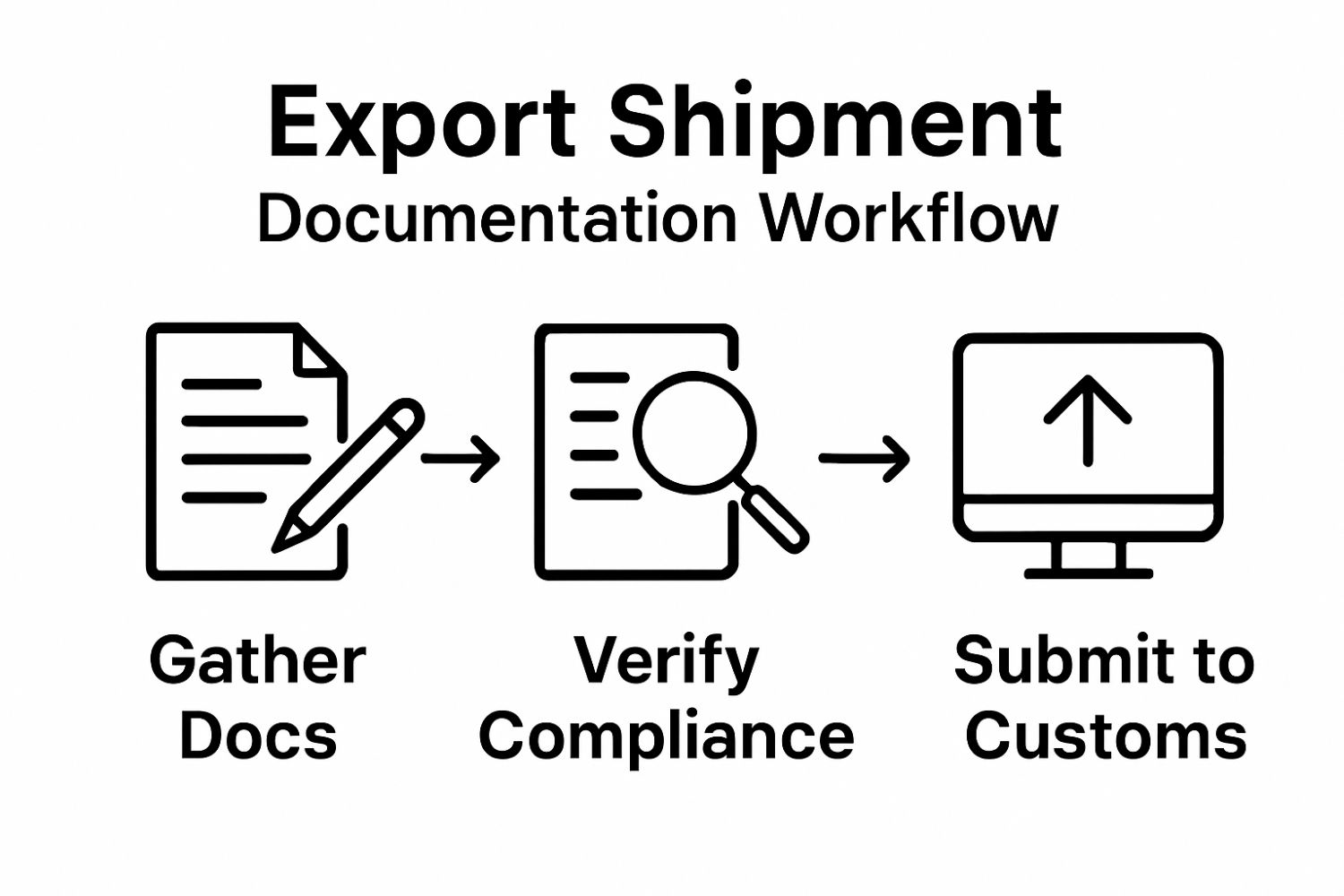
Customs authorities rarely open your container to stop a shipment. They stop it by looking at the paperwork. A vague product description on a commercial invoice, a packing list that doesn’t match the bill of lading, or a late ISF filing is all it takes to bring your supply chain to a halt. This guide covers the specific documents that trigger most customs holds, what goes wrong with each one, and how to audit your export documentation before the container sails.
Core Export Documents Required by US Customs
According to the 19 CFR 142.3 regulatory provisions, goods can only be released after complete entry documents are submitted. Standard entry materials cover CBP Form 3461 or its electronic equivalent, valid entry qualification certificates, commercial invoices, packing lists, and other special documents required by CBP or US federal agencies for specific cargo types. Four types of documents are mandatory for nearly all ocean freight shipments from China to the United States.
Commercial Invoice: Priority Review Document for CBP
Customs officers take the commercial invoice as the core reference for clearance review. All other shipment documents need to align with the information recorded in this invoice. Any errors on the commercial invoice will cause consistent deviations in the entire clearance process.
CBP regulations require commercial invoices to contain detailed and accurate cargo descriptions for official commodity classification. Standard invoice content includes full names and addresses of buyers and sellers, clear Incoterms of sales, itemized product lists with specific quantities and unit prices, total transaction value, product origin countries, and corresponding HTSUS subheadings for each commodity.
Vague product descriptions represent the most common invoice error. General terms such as “gifts” and “spare parts” do not meet customs declaration standards. The product description must be specific enough for customs staff to complete accurate classification without unpacking containers. For example, “500ml stainless steel insulated drinking water bottle” is a qualified declaration description, while the single word “bottle” is too ambiguous for clearance review.
Packing List: Document Required for Full Consistency with Invoice
Packing lists and commercial invoices have partial overlapping content including product information, quantities and shipment codes, but they serve different clearance purposes. Different from commercial invoices, packing lists do not record pricing or payment data. They only record physical cargo information such as packaging mode, cargo weight, product specifications and labeling details.
A standard valid packing list needs to mark the corresponding commercial invoice number, complete shipper and consignee information, itemized package details, accurate quantity data, gross and net weight, package dimensions and total package quantity. The most critical declaration rule is that all data fields on the packing list must be completely consistent with the corresponding content on commercial invoices and bills of lading. Any mismatch in product quantity, description or shipping marks will trigger manual customs review and inspection procedures.
Bill of Lading: Official Carriage Contract Certificate
A bill of lading has three core functions in cross-border logistics. It acts as an official carriage contract between shippers and carriers, a cargo receipt proof, and a legal document for goods ownership confirmation. Three mainstream types of bills of lading are widely used in ocean freight. Original bills of lading must be presented to complete goods pickup. Telex release supports goods delivery without original paper documents. Sea waybills are non-negotiable documents, which apply to long-term and trusted buyer-seller cooperation relationships.
For customs clearance work, the consignee information, notification party details and product descriptions recorded on bills of lading must fully match the content on commercial invoices and packing lists. Carriers usually issue official bills of lading after cargo loading. Our team recommends reviewing draft bills of lading before vessel departure to identify and correct data inconsistencies in advance.
ISF Filing: Non-negotiable 24-hour Pre-shipment Deadline
The Importer Security Filing, commonly known as the “10+2” filing rule, applies to all cargo transported by ocean vessels. Importers need to submit 10 types of cargo data, while carriers are responsible for providing 2 additional types of information. All filing materials must be uploaded electronically via the Automated Commercial Environment (ACE) system at least 24 hours before cargo loading at overseas departure ports.
CBP will impose fines of up to $5,000 for each ISF violation. Common violations include delayed submission, missing data items and inaccurate declared information. ISF filers must hold valid and compliant customs bonds. Since CBP only accepts filings from US-based entities, overseas importers need to authorize local US customs brokers or professional agents to complete ISF submission procedures.
| Document | Preparation Party | Submission Time | Common Errors |
|---|---|---|---|
| Commercial Invoice | Sellers / Factories | Before customs entry application | Vague product descriptions, missing HTS codes |
| Packing List | Sellers / Factories | Before customs entry application | Quantity data mismatch with commercial invoices |
| Bill of Lading | Carriers / Forwarders | After cargo loading completion | Inconsistent consignee information, mismatched product descriptions |
| ISF Filing | Importers / Authorized Brokers | 24 hours before cargo loading | Delayed filing, incomplete manufacturer information |
Source: 19 CFR 142.3; 19 CFR 149
Frequent Errors in Export Document Preparation
Multiple practical studies show that incomplete and inaccurate commercial invoices are the top cause of customs holds. Other major triggers include incorrect HS code classification, data mismatches between packing lists and invoices, and missing qualification certificates for special regulated goods.
HS Code Errors: Primary Cause of Customs Detention
Wrong HS code classification will directly change the applicable duty rate of goods. The rate gap can range from 3% to 12% in actual business scenarios. Incorrect codes may also trigger anti-dumping investigations and official compliance audits. The first six digits of HS codes are unified globally, while the last four digits vary by country and commodity category. Importers of record bear full legal responsibility for HS code accuracy. They cannot fully trust the code classification provided by product suppliers without secondary verification.
Cross-document Information Inconsistency
The three-way matching principle is a basic requirement for US customs clearance. Commercial invoices, packing lists and bills of lading must maintain consistent data in all overlapping fields. The covered content includes product descriptions, quantity units, total cargo volume, shipping marks, country of origin and consignee details. Even minor data discrepancies, such as 5,000 pieces recorded on invoices and 5,200 pieces on packing lists, will lead to customs holds and manual inspections.
Checklist 1: Three-Way Document Consistency Check
- Product descriptions remain identical on invoices, packing lists and bills of lading
- Product quantities and measurement units are consistent across all three documents
- Shipping marks maintain unified presentation in all declaration materials
- Country of origin information is clearly displayed on invoices and packing lists
- Full consignee names and addresses are completely consistent in all documents
- Valid commercial invoice numbers are marked on corresponding packing lists
- Total package quantity matches the statistical data on packing lists
Vague and Misleading Product Descriptions
Customs officers verify the consistency between declared cargo information and actual goods mainly through commercial invoices. Improperly generalized descriptions will block the clearance process. Simple terms like “electronics” and “accessories” fail to meet declaration standards. Qualified product descriptions need to specify product categories, main production materials and usage scenarios. For goods regulated by special industry standards including children’s products, food contact supplies and wireless electronic devices, the description content must reflect relevant product attributes to comply with regulatory requirements.
Pre-shipment Document Audit Methods
HS Code Verification Before Shipment
Exporters can use the official HTS search tool launched by USITC to confirm 10-digit commodity codes, applicable duty rates and special regulatory requirements. The additional requirements cover anti-dumping duties, import quotas and mandatory license certification. If commodity classification standards are ambiguous, importers can apply for binding ruling documents from CBP or consult licensed customs brokers for professional confirmation. Pre-shipment code correction only generates low time and cost losses. Once goods arrive at destination ports, code reclassification may lead to supplementary duty payments, official penalties and long-term customs audits.
ISF Data Accuracy Confirmation
All data submitted for ISF filing must match the recorded information on commercial invoices and bills of lading. The 10 core filing elements contain manufacturer names and addresses, buyer and seller information, consignee details, container stuffing locations, product origin countries, six-digit HTSUS codes and importer business certification numbers. Inaccurate ISF data will result in the same penalty standards as delayed filing operations.
Standard Pre-shipment Document Audit Timeline
Commercial invoices and packing lists need to be finalized at least 72 hours before official cargo loading. The ISF filing work must be completed 24 hours in advance of loading. The draft version of bills of lading requires full review 48 hours before vessel departure. For goods regulated by FDA, FCC or CPSC rules, relevant qualification certificates need to be confirmed and sorted out one week before shipment to avoid regulatory risks.
| Document | Finalization Time | Review Party | Delay Consequences |
|---|---|---|---|
| Commercial Invoice | 72 hours before cargo loading | Importers / Authorized Brokers | Customs holds at destination ports |
| Packing List | 72 hours before cargo loading | Importers / Authorized Brokers | Manual customs review and physical cargo inspection |
| ISF Filing | 24 hours before cargo loading | Importers / Authorized Brokers | Up to $5,000 fine per violation |
| Bill of Lading Draft | 48 hours before vessel departure | Importers | Consignee information mismatch and goods delivery delays |
Impact of Trade Terms on Document Preparation Responsibilities
Document Division Rules Under FOB, CIF and EXW
Under FOB trade terms, sellers complete export customs clearance and cargo loading work. Buyers take charge of main ocean freight arrangement and import clearance procedures. Buyers usually obtain bills of lading from freight forwarders and control the overall ISF filing process. Under CIF trade terms, sellers arrange ocean freight and cargo insurance, but buyers still serve as importers of record to undertake customs-related legal responsibilities.
Under EXW trade terms, buyers are responsible for all logistics and clearance links starting from factory cargo pickup. The scope includes China’s local export clearance procedures, which is difficult for overseas buyers to complete independently without local professional sourcing agent support.
Limitations of Supplier-provided Original Documents
Commercial invoices directly provided by factories often fail to meet CBP formal clearance standards. These documents commonly lack standard HTSUS codes, adopt generalized product descriptions and omit clear Incoterm labels. Importers need to take factory invoices as basic reference materials rather than final declaration documents. All invoice content must be fully reviewed and revised. Data consistency with packing lists and bills of lading needs to be confirmed before official customs submission.
2026 CBP Proposed Policy Changes for Import Declaration
New Requirements for Overseas Export Documents
CBP released an Advance Notice of Proposed Rulemaking on September 2, 2026. The new policy titled “Heightened Import Disclosures for Supply Chain Visibility” plans to raise the supervision standard of import declaration materials. The rule requires importers to sort and retain all overseas export declaration documents. The reserved materials cover export declaration forms, commercial invoices, packing lists, export licenses and international transport documents submitted to local customs authorities.
Once the new rule is officially implemented, importers must obtain complete export document copies from Chinese suppliers or local agents for CBP inspection. The public comment period for the new policy will end on December 1, 2026. Importers can start confirming suppliers’ document provision capabilities in advance to adapt to new regulatory requirements.
Replacement Plan of MID Codes by Global Business Identifiers
CBP is also planning to replace the traditional Manufacturer Identification (MID) codes with universal global business identifiers. The alternative codes include D-U-N-S, GLN and LEI. This optimization will improve the accuracy of manufacturer and supply chain participant identification. Importers need to ensure their cooperative suppliers have valid and verifiable global business identification data to adapt to the new declaration rules.
Conclusion
Export document preparation is not a trivial clerical work. It is the core basis for customs officers to verify cargo information before container unpacking. Vague invoice descriptions, inconsistent packing list data and delayed ISF filing are not minor operational mistakes. They are the main causes of port detention and clearance failure for cross-border shipments.
The core of compliant declaration lies in four key steps. Businesses need to verify the accuracy of HS codes strictly, ensure full data consistency among invoices, packing lists and bills of lading, complete ISF filing within the specified time limit, and review and revise supplier-provided documents before submission. At Keen Sourcing, our team provides professional pre-shipment document review services for importers. We complete three-way data cross-check, HTS code verification and ISF data calibration. We timely identify and correct all inconsistent document information before container departure. Our team does not replace licensed customs brokers or undertake their professional work. We provide the last round of compliance inspection for documents before goods leave China. Businesses can contact us to apply for professional document review services for subsequent shipments.
Frequently Asked Questions
References
- S. Customs and Border Protection. “Commercial Invoice Requirements.” https://www.help.cbp.gov/s/article/Article-1175
- S. Customs and Border Protection. “Entry Documentation Required – 19 CFR 142.3.” https://www.ecfr.gov/current/title-19/section-142.3
- S. Customs and Border Protection. “Importer Security Filing – 19 CFR 149.” https://www.ecfr.gov/current/title-19/part-149
- “Shipping Documents That Cause Customs Holds & Fixes.” https://ship4wd.com/shipping-documents/documents-that-cause-the-most-customs-holds-and-how-to-fix-them
- “Commercial Invoice vs. Other Invoices.” https://www.dhl.com/discover/en-my/logistics-advice/essential-guides/commercial-invoice-vs-other-invoices
- “Importer Security Filing Requirements.” https://uscib.org/faq-items/importer-security-filing-requirements/
- “Key Freight Documents for Sea Freight 2026.” https://www.freightamigo.com/en/blog/logistics/key-freight-documents-for-sea-freight-and-freight-forwarding-in-2026/
- “Before You Ship Internationally: 4 Mistakes to Avoid.” https://about.ups.com/
- S. International Trade Commission. “Harmonized Tariff Schedule Search.” https://hts.usitc.gov/
- “ISO 9001:2015 – Quality Management Systems.” https://www.iso.org/standard/62085.html

As a Vice President at Keen Sourcing, I am dedicated to helping overseas buyers source reliable products from China with confidence. Based in Shanghai, Keen Sourcing supports international clients through product sourcing, factory sourcing, order follow-up, and quality control, ensuring that every project meets high standards for quality, compliance, cost efficiency, and transparency.
Click and connect Eric Fang on Linkedin


