
Leatherman has been manufacturing in Portland, Oregon since 1983, employs over 540 full-time staff, and builds more than 30 multitool models from 800-pound steel coils. But behind the “Made in USA” label lies a more nuanced supply chain. A 2006 California Court of Appeal ruling in Colgan v. Leatherman Tool Group found that multiple parts of Leatherman’s multitools were “substantially made outside the United States,” including components that were investment cast, fineblanked, formed, hardened, cut, forged, polished, or machined in foreign facilities. Leatherman subsequently adjusted its packaging to read “Made in USA of U.S. and global components.” As a Chinese sourcing agent that works with hardware and tool manufacturers, Keen Sourcing knows which factories operate at Leatherman’s component-manufacturing level—and how to connect your brand with them.
Where Are Leatherman Multitools Actually Manufactured?
Portland, Oregon: The Brand’s Manufacturing Core
Leatherman established its brand and headquarters in Portland, Oregon in 1983, and the core operational base has remained in this region ever since. More than 540 full-time employees work for the enterprise, and around 400 staff members are stationed at the local Portland production plant. The factory develops and manufactures over 30 types of tool products. Raw steel materials in 800-pound coil forms go through stamping, mechanical processing, heat treatment and assembly procedures in this plant. Leatherman officially states that all finished multitool products are manufactured in Portland, and all performance tests are completed in the Pacific Northwest region.
The “Made in USA with Global Parts” Reality
The production system of Leatherman tools is not completely dependent on American domestic manufacturing. The 2006 court judgment forced Leatherman to make a public disclosure. The brand’s multitool products cannot be simply defined as US-made goods, because numerous parts rely on foreign production facilities, labor resources and processing technologies. This is why the brand updated its product labeling to include global component descriptions. This operational mode is very common in the high-end multitool industry. Most premium tool brands source specialized components from global suppliers. For product purchasers, the core evaluation standard lies in whether overseas cooperative factories can reach unified precision and durability benchmarks.
What This Means for Buyers Seeking Leatherman-Level Manufacturing
Many brand purchasers aim to develop multitools with the same quality level as Leatherman products. Production process control capability, rather than manufacturing location, acts as the core evaluation standard for qualified factories. Qualified manufacturers need to complete forging and stamping of parts within strict tolerance ranges. They must conduct professional heat treatment for tool blades to achieve appropriate hardness. The locking structures of finished products need to keep smooth operation after thousands of opening and closing cycles. Our team has long-term cooperation experience with multiple factories that supply qualified components for Leatherman’s global supply system.
What Does Leatherman’s Manufacturing Process Actually Involve?
Forging, Stamping, and Precision Machining
The whole production process of Leatherman multitools starts with 800-pound steel coil raw materials. Large-scale stamping equipment processes most metal parts, and laser cutting technology shapes partial flat steel components. The brand adopts a professional coining process. Industrial presses apply tons of pressure to bend metal materials into preset shapes. All product parts feature extremely strict dimensional tolerances, ranging from ±0.001 to ±0.003 inches. This strict standard ensures all components can achieve precise matching and seamless assembly in subsequent procedures.
Heat Treatment and Surface Finishing
Every single component of Leatherman multitools undergoes independent heat treatment before assembly work starts. Ceramic bead tumbling treatment is applied to processed parts after heat treatment. This step removes rough surface burrs and achieves a smooth polishing effect. Some key components such as tool blades are sent to professional external institutions for specialized heat treatment. This segmented processing mode is widely adopted in high-end tool manufacturing industries. The heat treatment procedure needs to balance two core indicators. It must guarantee sufficient blade hardness for long-term edge retention, while avoiding excessive hardness that causes material brittleness. Reliable premium tool factories must record complete heat treatment parameters, including processing temperature, heat preservation time and quenching medium. Factories that cannot provide such detailed data are not suitable for high-end multitool production cooperation.
Assembly, Tension Calibration, and Quality Control
Precise pivot tension calibration serves as the key step in the product assembly stage. Multiple core user experiences are determined by accurate tension control. These experiences include the opening feel of the whole tool, the tightness of locking structures and the alignment precision of plier jaws. A multi-dimensional quality inspection system is implemented after assembly completion. The system covers first-article inspection for new products, batch sampling inspection for mass production and CMM (coordinate measuring machine) precision verification.
Where in China Can You Find Leatherman-Level Multitool Manufacturing?
Yangjiang, Guangdong: China’s Hardware and Tool Capital
Yangjiang City in Guangdong Province is recognized as the core production base of hardware and cutting tools in China. The total output value of the city’s hardware, knife and scissors industry exceeded 55 billion yuan (about 7.52 billion US dollars) in 2024. Its industrial output accounts for 75% of China’s total production volume, and its export share reaches 85% of the national total. The city hosts more than 2,000 professional hardware knife and scissors manufacturers. Over 8,500 supporting industrial enterprises also gather in this region. These local manufacturers produce more than 5,000 types of hardware products, which are exported to over 130 countries and territories worldwide.
What Capabilities Yangjiang Factories Can Offer
Local Yangjiang factories with mature multitool production capacity possess complete industrial configuration and professional production capabilities, which are displayed in the table below:
| Capability | Details |
|---|---|
| CNC Machining | Multi-axis machining centers capable of holding ±0.001 inch tolerances |
| Stamping & Forging | Progressive stamping presses, coining equipment for handle and jaw forming |
| Heat Treatment | In-house or partnered heat treatment lines with documented parameters |
| Materials | Stainless steel (420HC, 440C), D2 tool steel, 14C28N premium blade steel |
| Handle Materials | Aluminum alloy, titanium, G10, Micarta |
| Surface Finishing | Stone wash, black oxide, PVD coating, bead blast |
| Certifications | ISO 9001, BSCI, SMETA |
| OEM/ODM Services | Full custom design, logo engraving, packaging development |
Source: Industry cluster data and factory capability disclosures.
How to Verify a Factory Has Genuine Multitool Capability
Trusted multitool manufacturers with professional production qualifications can provide complete verification materials. These valid proofs include operational heat treatment equipment records, regular stamping die maintenance logs, CNC machining tolerance inspection reports and cycling test data of tool locking structures. Factories that only produce simple stamped hardware accessories cannot manufacture high-precision multitools. The core technical difficulty of multitool production lies in ensuring accurate alignment of multiple components on a unified pivot structure.
How Can Your Brand Source Multitools at Leatherman’s Manufacturing Level?
Matching Your Product to the Right Factory
Multitool products have obvious differences in structural complexity, which corresponds to different production standards. Mini keychain multitools with 2 to 5 functions only need basic stamping and assembly processes. EDC portable multitools with 7 to 10 functions require professional CNC machining and standardized heat treatment procedures. Full-size professional multitools with 14 to 21 integrated functions need comprehensive processing technologies, including forging, precision CNC machining, heat treatment and strict tension calibration. The corresponding MOQ standards and production requirements are sorted in the table below:
| Product Tier | Typical MOQ Range | Key Manufacturing Requirements |
|---|---|---|
| Keychain / mini tool | 500–1,000 pieces | Basic stamping, assembly |
| Compact EDC tool | 1,000–2,000 pieces | CNC machining, heat treatment |
| Full-size professional | 1,000–3,000 pieces | Forging, precision CNC, heat treatment, tension calibration |
How Keen Sourcing Helps Buyers Access These Manufacturers
We have established long-term stable cooperative relationships with professional tool manufacturers in Yangjiang and other major hardware industrial clusters in China. Relying on these deep industry partnerships, we help our clients obtain more competitive factory quotations and flexible payment terms. These preferential cooperation conditions are rarely available for individual overseas buyers. We do not resell finished products of any brand. Our core service is to help global brand purchasers build independent, stable and high-quality product supply chains.
| Stage | What We Do |
|---|---|
| Product specification | Define materials, construction method, hardware, and compliance requirements |
| Factory matching | Identify factories with the specific capability your product requires |
| Factory audit | Verify equipment, certifications, production capacity, and quality systems on-site |
| Sample development | Coordinate prototype production and review against specifications |
| Price negotiation | Negotiate factory-direct pricing and payment terms |
| Production monitoring | Track progress, conduct in-process checks, and manage timelines |
| Pre-shipment inspection | AQL-based final inspection before goods leave the factory |
| Logistics | Coordinate FOB shipping, consolidation, and documentation |
What to Expect in Timeline and Investment
The whole customized multitool development cycle covers concept confirmation to final shipment, which usually takes 90 to 150 days. Each round of sample production and modification requires 7 to 15 days, and most customized projects need two to three rounds of iterative optimization. Custom component tooling production takes an additional 15 to 30 days. Mass production starts after sample confirmation, with a production cycle of 30 to 45 days. The following checklist covers core pre-development confirmation items for multitool projects:
What Do Leatherman’s Best-Selling Multitools Reveal About Manufacturing Standards?
Amazon’s Most-Reviewed Leatherman Models
Customer feedback data of mainstream products can intuitively reflect the market recognition standard of premium multitools. The following table sorts out classic Leatherman products with large review volumes on Amazon platforms, which can represent the brand’s mainstream manufacturing standards. All data is verified and updated to 2026.
| Product | Tools | Rating | Review Count | Key Features |
|---|---|---|---|---|
| https://www.amazon.com/dp/B0058EJ2MK | 14-in-1 | 4.7 stars | 9,966+ | Spring-action pliers, one-hand opening blade, pocket clip |
| https://www.amazon.com/dp/B079MJBP21 | 18-in-1 | 4.8 stars | 5,959+ | Replaceable wire cutters, spring-action scissors, all-locking |
| https://www.amazon.com/dp/B0043NYPA6 | 7-in-1 | 4.8 stars | 5,664+ | Carbon fiber handle, 154CM blade, carabiner clip |
| https://www.amazon.com/dp/B019EN86IG | 17-in-1 | 4.7 stars | 3,448+ | Replaceable wire cutters, all-locking tools, compact design |
Source: Amazon product listings. Review counts verified as of 2026.
Product review volume is positively correlated with market sales volume and user satisfaction. Products with tens of thousands of high-star reviews can maintain stable quality performance in mass production. This stable product performance is determined by standardized manufacturing processes rather than brand marketing strategies.
What Users Actually Complain About (and Praise)
User reviews of Leatherman core products show obvious consistent feedback. Consumers of the Wave+ series highly recognize the product’s material quality, overall durability and humanized structural design. Buyers of the Wingman series point out that the product achieves a good balance between portability and practicality. It is light enough for daily carrying and sturdy enough for various operational scenarios. Most user complaints focus on product weight and slight stiffness in the initial use stage. Serious quality problems such as failed locking structures, blade chipping and hardware damage are extremely rare in user feedback. For brands developing self-owned premium multitools, these indicators set a clear production standard. Qualified products need to maintain long-term structural stability, tight locking performance and non-degrading material quality.
The Manufacturing Difference Between Technical and Standard Multitools
Standard multitools and high-end technical multitools have similar outer appearances, but huge differences in internal manufacturing details. Premium products adopt reinforced pivot structures and stress-reinforced welding positions, and are equipped with high-grade blade steel materials. The product force transmission path is professionally designed from the handle to the plier structure, instead of relying on simple flat frame force bearing. The heat treatment process directly decides the blade’s edge retention ability and impact resistance. These core performance differences are all derived from standardized manufacturing technologies, not superficial product designs.
How Does Keen Sourcing Verify Quality at the Factory Level?
Pre-Production Verification
Our team conducts comprehensive parameter verification before mass production starts. We check all raw material indicators against client requirements, including steel grade certificates, standardized heat treatment parameters, component tolerance data and surface finishing standards. We confirm the accuracy of engineering drawings and industry certification standards in advance. All component inspection certificates are archived completely to ensure full product traceability.
During-Production Inspection
Our professional inspectors conduct on-site inspections at key production nodes. The inspection links cover post-stamping processing, post-heat treatment processing and finished assembly. We test welding firmness, component assembly accuracy, dimensional standard compliance and surface appearance quality. Timely on-site inspection can effectively discover potential defects and avoid large-scale batch product quality problems.
Pre-Shipment Inspection and Compliance Support
We carry out full-range product inspection before all goods are shipped. The inspection contents include material authenticity verification, dimensional precision detection, functional testing of locking structures, plier alignment and blade expansion, surface finishing quality check, packaging and label verification, and quantity statistics. Only products that pass all inspection items can be delivered. We also provide targeted compliance certification services for different target markets, including CE, FCC, RoHS, UL, PSE and RCM certifications. We cooperate with authoritative third-party testing institutions such as SGS and Intertek, and provide complete test reports for client filing. The following checklist lists key verification items for professional multitool manufacturers:
Ready-to-Ship Multitools from Keen Sourcing
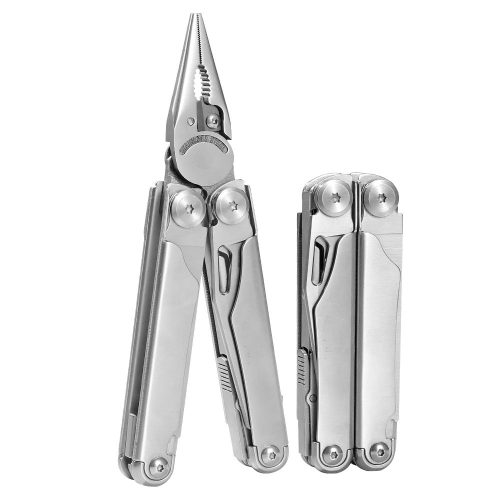
Unit Price: USD $6.03-6.38
Leave online message or send email to [email protected] to order.
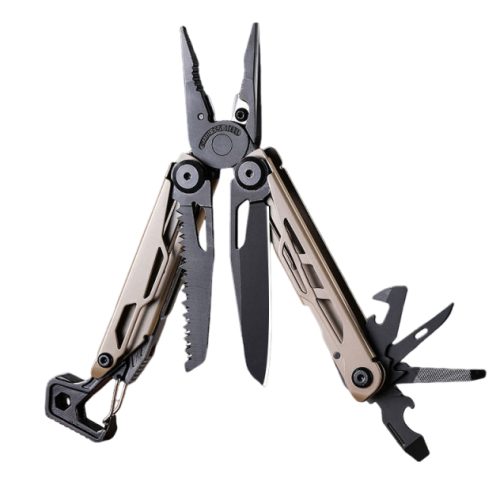
Unit Price: USD 5.09-5.99
Leave online message or send email to [email protected] to order.
Brands that need high-quality multitool products in a short cycle can choose our ready-to-ship finished products. These products are manufactured by our long-term cooperative qualified factories, which saves the 90–150 days customized development cycle. Relying on our stable industry resources, we can provide clients with exclusive pricing that individual buyers cannot obtain independently.
You can contact us to customize exclusive multitool products that meet your precise specifications.
Frequently Asked Questions
Conclusion
Leatherman adopts a production mode combining American finished product assembly and global component supply. The brand’s Portland factory is responsible for core precision assembly and pivot tension calibration processes, which create the unique use feel of Leatherman products. Various high-precision components that meet the brand’s strict tolerance standards are sourced from global overseas manufacturers. For brands intending to develop high-standard multitools, the core development direction is not to copy existing Leatherman products, but to match equivalent high-level manufacturing capabilities. This requires screening professional factories with mature forging, heat treatment and precision machining technologies. It is also necessary to strictly verify factory equipment and certification qualifications, and conduct full-process quality management from sample development to mass production. Our team provides one-stop sourcing services for global brand owners to help clients build high-quality multitool supply chains that meet international premium standards. If you have a multitool development plan, you can share your product demands with us, and we will formulate a targeted manufacturing and cooperation plan for your project.
References
- People’s Daily Online. “Scale of knife and scissor industry exceeds 55 billion yuan in Yangjiang, S China’s Guangdong.” http://en.people.cn/n3/2025/0122/c90000-20269164.html
- Women in Manufacturing. “Leatherman Factory Tour and Happy Hour.” https://www.womeninmanufacturing.org/events/wim-oregon-leatherman-factory-tour-and-happy-hour
- Men’s Journal. “This Leatherman Multitool Is a Rare 22% Off for Cyber Monday.” https://www.mensjournal.com/
- SlashGear. “Where Are Leatherman Tools Made & Who Owns The Company?” https://www.slashgear.com/2161013/who-owns-leatherman-where-are-multitools-made/
- Leatherman. “Wave+ Multi-Tool.” https://www.leatherman.com/
- ISO. “ISO 9001:2015 – Quality Management Systems.” https://www.iso.org/standard/62085.html

As a Vice President at Keen Sourcing, I am dedicated to helping overseas buyers source reliable products from China with confidence. Based in Shanghai, Keen Sourcing supports international clients through product sourcing, factory sourcing, order follow-up, and quality control, ensuring that every project meets high standards for quality, compliance, cost efficiency, and transparency.
Click and connect Eric Fang on Linkedin